


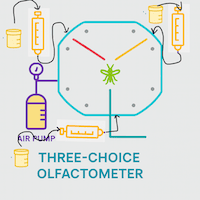
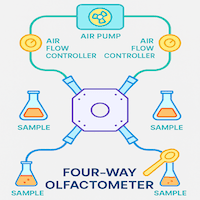
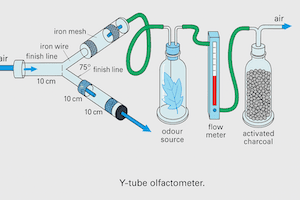
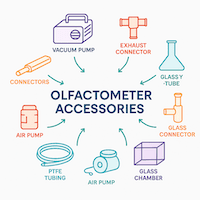





🧪 Y-Tube Olfactometer — How Data is Recorded
A practical guide to decision points, observation rules, and data validation
1. When is a “choice” recorded?
↑ Back to ContentsIn most published protocols, a choice is NOT recorded just because the insect crosses the junction.
👉 Standard practice:
- The insect must enter an arm and pass a defined decision point
- This is usually:
- 1/3 to 1/2 of the arm length, OR
- A pre-marked line (~3–5 cm from the junction)
✔️ So:
- ❌ Crossing the junction = NOT a valid choice
- ✔️ Crossing a decision line in one arm = VALID choice
👉 Why? Because insects often “probe” both arms briefly. Recording at the junction would give false positives.
2. What if insect crosses halfway in an arm?
↑ Back to Contents✔️ Yes — this is usually considered a valid and final choice IF:
- The insect crosses the decision threshold (halfway or marked line)
- And stays oriented forward (not just touching and returning immediately)
👉 Many labs define:
- “Choice = insect moves X cm into one arm and remains for ≥ 5–10 seconds”
3. What if insect enters and then returns?
↑ Back to ContentsThis is important 👇
Case A: Did NOT cross decision line
- ❌ Not counted
- Recorded as:
- “No choice” OR
- “Undecided”
Case B: Crossed decision line, then came back
- ✔️ Usually counted as a choice already made
- Movement back is ignored
👉 Reason: The first committed movement is considered the behavioral response.
4. How is time spent recorded?
↑ Back to ContentsThere are two approaches, depending on study type:
A. Choice-based studies (most common)
- Only final choice is recorded
- Time is secondary:
- “Time to first choice” (latency)
B. Behavioral analysis studies
Time is recorded as:
- Time spent in each arm
- Time in central zone
- Number of entries into each arm
👉 This is done by:
- Stopwatch (manual)
- OR video tracking software (preferred in research)
5. How long should each insect be observed?
↑ Back to ContentsTypical duration:
- 3 to 5 minutes per insect
Rules:
- If insect makes a choice → stop early
- If no choice within time limit → mark as:
- “No response” / “Non-responder”
👉 Important:
- Non-responders are usually excluded or reported separately
6. How many insects are needed?
↑ Back to ContentsTypical:
- 20–50 insects per treatment
And:
- Repeat experiments across days for reliability
7. How to ensure data is valid?
↑ Back to ContentsGood Y-tube experiments follow these controls:
✔️ Airflow control
- Equal airflow in both arms
- No turbulence
✔️ Odor switching
- Swap odor sides regularly (to avoid positional bias)
✔️ Cleaning
- Clean Y-tube after few insects
- Prevent odor contamination
✔️ Control test
- Run clean air vs clean air
- Expect ~50:50 distribution → confirms no bias
8. What data is finally analyzed?
↑ Back to ContentsMost common output:
- % insects choosing odor A
- % insects choosing odor B
- % no response
Statistical tests:
- Chi-square test
- Binomial test
🔑 Simple Practical Summary
↑ Back to Contents- Crossing junction ❌ = not counted
- Crossing halfway ✔️ = counted
- Returning after crossing ✔️ = still counted
- Time measured = optional (latency or duration)
- Observation time = ~3–5 min
- Non-responders = recorded separately
📥 Please download here a sample file to record data for Y-tube olfactometer