












Y-tube Olfactometer for Small Clawed Legged Insects with SS Mesh
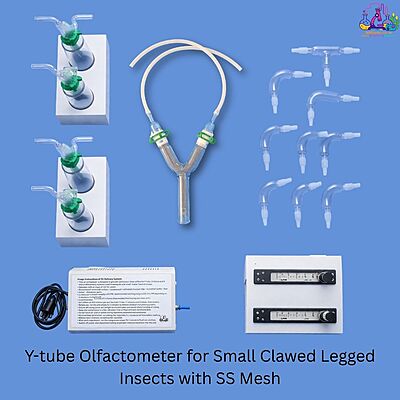
The Y-Tube Olfactometer for Small Claw-Legged Insects with SS Mesh is a specialized glass apparatus designed for insect behavioral and olfactory studies involving small crawling species. It features an internal stainless steel (SS) mesh that provides enhanced grip, allowing insects to move naturally and ensuring accurate odor-choice responses under controlled laboratory conditions.
Here, L denotes length and Ø denotes diameter, with all dimensions expressed in millimeters (mm).
Dimension Explanation Table
| Symbol / Term | Meaning | Description |
|---|---|---|
| L (Stem) | Length of main tube | Distance from inlet to junction |
| Ø (Stem) | Diameter of main tube | Inner diameter for airflow and insect movement |
| L (Arm) | Length of each arm | Distance from junction to outlet |
| Ø (Arm) | Diameter of each arm | Inner diameter of arms |
Variants
| Variant | Stem (L, Ø) mm | Arm (L, Ø) mm |
|---|---|---|
| V1 | (60, 10) | (50, 10) |
| V2 | (60, 15) | (70, 15) |
| V3 | (60, 20) | (60, 20) |
| V4 | (60, 8) | (110, 8) |
| V5 | (60, 10) | (110, 10) |
Customize
Product Details
The Y-Tube Olfactometer for Small Claw-Legged Insects with SS Mesh is a precision laboratory instrument developed for entomological research involving insects with gripping or clawed legs, such as ticks, mites, beetles, and other crawling species. Standard glass surfaces can restrict movement and lead to inconsistent behavioral responses. This model addresses that limitation by incorporating an internal stainless steel (SS) mesh, which acts as a textured walking surface, significantly improving insect mobility and response accuracy.
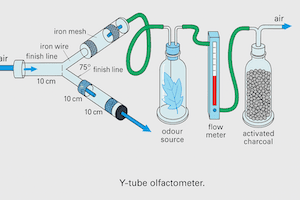
The Y-shaped design consists of a central stem through which insects are introduced, leading to two arms that present separate odor environments. This dual-choice setup is widely used to evaluate insect attraction, repellency, and olfactory preference under controlled airflow conditions.
Constructed from high-quality borosilicate glass, the olfactometer offers excellent transparency, durability, and resistance to chemical exposure. The smooth internal geometry supports uniform airflow with minimal turbulence, ensuring consistent odor delivery and reproducible experimental results.
Multiple variants are available to suit different insect sizes and experimental setups. Smaller diameters are ideal for tiny insects and precise airflow control, while longer arms allow extended observation and improved behavioral tracking.
The transparent construction enables clear observation of insect movement, and the design integrates seamlessly with air compressors, airflow controllers, charcoal filters, and humidifier systems, forming a complete olfactometer setup.