


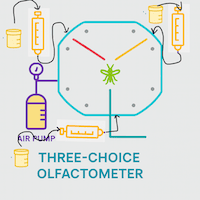
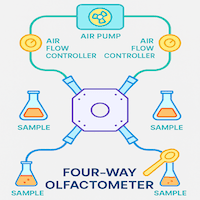
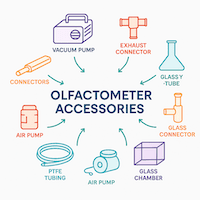








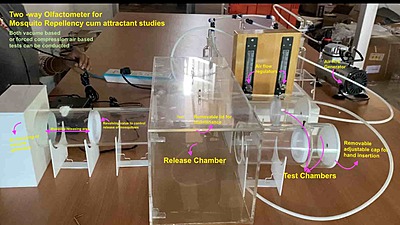
Olfactometer for Mosquitoes WHO Design for Repellency Test
The WHO Olfactometer for Repellency Testing on Mosquitoes is a specialized behavioral assay system designed for evaluating the repellency, attractiveness, and host-seeking responses of mosquitoes under controlled laboratory conditions. The system supports both chemical stimulus testing using compressed air delivery and human skin/hand-based testing using a dedicated vacuum-flow system. Supplied as a complete package with airflow conditioning components, humidity control, flow meters, PTFE tubing, and vacuum setup, it provides researchers with a reliable platform for mosquito behavior studies, repellent evaluation, and vector control research.
🔬 System Components (Included Units)
Activated Charcoal Chamber for Olfactometer – 1 unit
Ensures purified, odor-free airflow by removing contaminants and background odors before entering the test chambers.Air Compressor or Pump – 1 unit
Provides consistent and regulated airflow to the test apparatus, essential for maintaining flow balance and reliable mosquito behavior observation.Humidity Chamber for Olfactometer – 1 unit
Maintains the desired humidity levels, mimicking realistic environmental conditions for mosquito responses.PTFE Tubings – 1 unit
Chemical-resistant, non-reactive PTFE tubes ensure that test compounds remain unaltered during airflow delivery to the Y-tube.Olfactometer for Entomology – 1 unit
The central unit where mosquitoes are introduced and exposed to different odor sources. It features a transparent bifurcated design allowing insects to choose between two odor paths, facilitating behavioral data collection.0.1 - 1.0 LPM Air Regulator – 2 pcs
Provides precise control and monitoring of airflow (1 liter per minute) to each arm of the Y-tube to ensure uniform test conditions.Vacuum Setup for Hand-Placed Testing – 1 unit
For repellency testing involving live human skin or hands, a vacuum-based airflow system is provided. This setup draws air across the hand placed in the testing provision and into the Y-tube chamber without using flow regulators, offering smooth and adjustable air movement.
Customize
Product Details
The WHO Olfactometer for Repellency Testing on Mosquitoes is a complete Y-tube behavioral testing system developed for entomological research, vector control studies, repellent efficacy evaluation, and mosquito host-seeking behavior analysis.
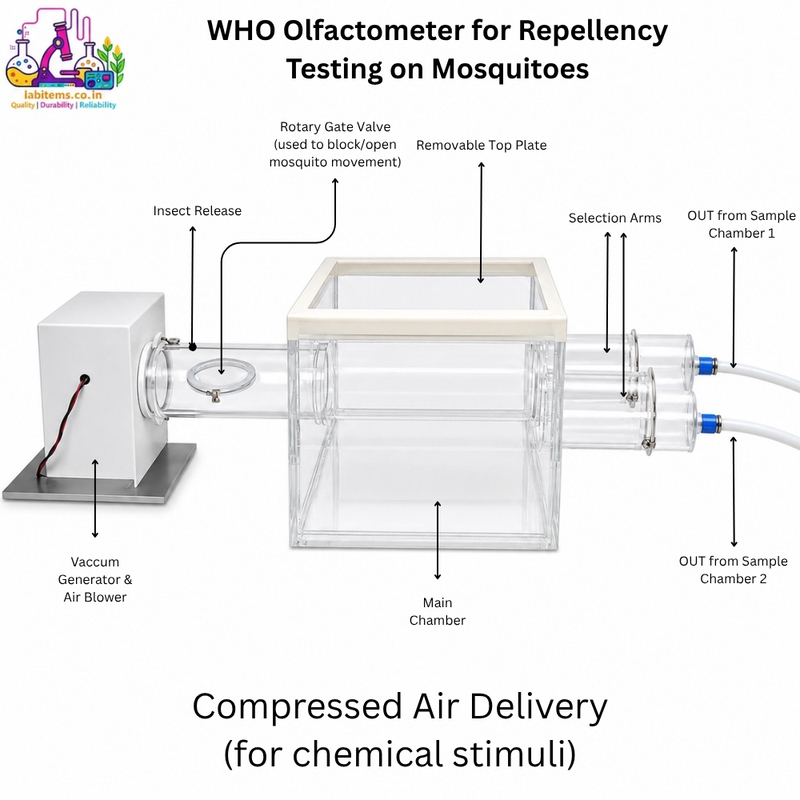
Designed in accordance with WHO-recommended olfactometer testing principles, the system allows researchers to expose mosquitoes to two separate odor streams and observe directional responses under carefully controlled airflow conditions.
The transparent testing chamber incorporates a removable top cover, mosquito release section, rotary gate valve, and dual selection arms, allowing easy observation and reproducible behavioral measurements.
A key advantage of this system is its dual airflow configuration, enabling testing of both chemical compounds and human-derived odors.
⚙️ Air Delivery Modes: Dual System Design
1. Compressed Air Delivery Mode
(For Chemical Stimuli Testing)
This mode is used when testing:
- Synthetic repellents
- Essential oils
- Plant extracts
- Attractants
- Semiochemicals
- Volatile organic compounds
Air is passed through:
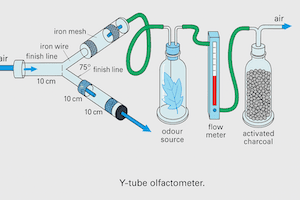
Activated Charcoal → Humidity Generator → Flow Meter → Sample Chamber → Olfactometer
Each sample chamber is equipped with an independent airflow regulator, allowing airflow adjustment from:
0.1 to 1.0 LPM
This ensures precise and balanced airflow delivery to both olfactometer arms.
Advantages
✓ Precise airflow regulation
✓ Suitable for low-volume chemical samples
✓ Controlled and reproducible test conditions
✓ Ideal for repellent efficacy studies
2. Vacuum-Based Flow Mode
(For Hand/Skin Repellency Testing)
This mode is specifically designed for:
- Hand repellency studies
- Skin odor attractiveness studies
- Human host preference testing
- Treated vs untreated skin comparisons
In this configuration, the vacuum system gently draws air across the hand or skin surface placed within the testing provision.
The airflow is then directed into the olfactometer chamber, carrying natural skin odors or repellent-treated odors to the mosquitoes.
Because the testing chamber incorporates its own airflow management design, this mode operates independently of the compressed-air flow regulators.
Advantages
✓ Suitable for direct human skin testing
✓ Natural odor delivery
✓ Stable airflow conditions
✓ Simplified operation
✓ Enhanced realism for host-seeking studies
Chamber Cleaning Procedure
To eliminate residual odors between experiments:
- Do not remove the top cover plate initially.
- Reverse the vacuum pump/blower to create forward airflow through the chamber.
- Allow air to pass through the entire system as illustrated.
- Maintain airflow for a minimum of 45 minutes.
- After complete odor removal, open the chamber and proceed with cleaning if required.
This procedure minimizes cross-contamination between successive experiments.
✅ Applications
Evaluation of repellent compounds (natural and synthetic)
Mosquito behavior analysis for attractant or deterrent studies
Comparative testing of treated vs. untreated human skin
Research in vector control, public health entomology, and product development